
The 0.005 BTC Question: Hashrate, Days and Pool Luck
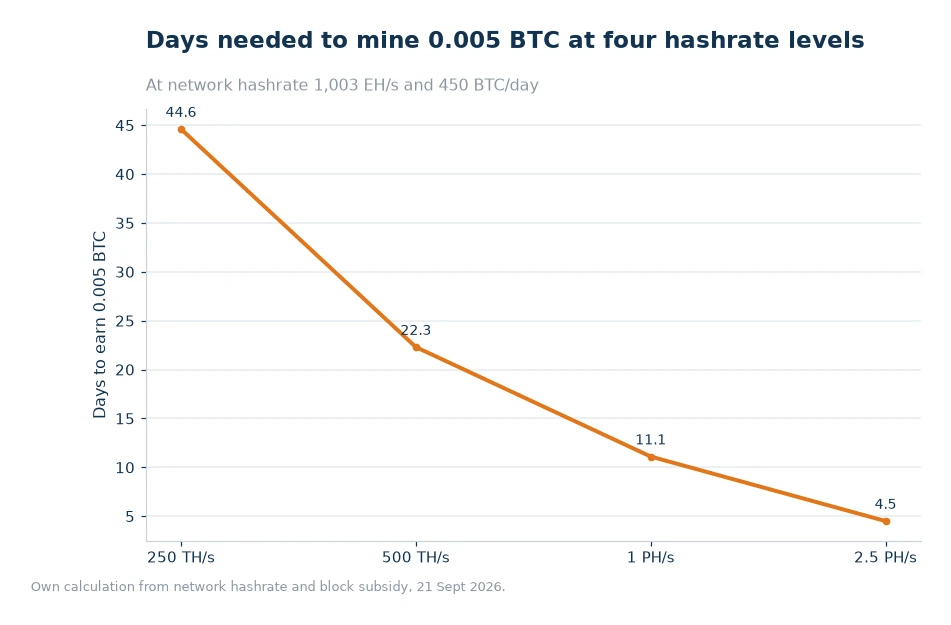
Half of one hundredth of a bitcoin is $423.46 at $84,692 per BTC, and the time it takes to mine depends on one ratio. At 250 TH/s the wait is 44.6 days; at 500 TH/s it is 22.3; at 1 PH/s it is 11.1; at 2.5 PH/s it is 4.5. Those figures assume a network hashrate of 1,003 EH/s and a subsidy of 3.125 BTC per block. Change either and every row moves, which is why the ratio deserves more attention than the target.

Key takeaways
- 250 TH/s needs 44.6 days for 0.005 BTC; 2.5 PH/s needs 4.5 days at the same network hashrate.
- 250 TH/s produces 0.00011215 BTC a day, which is $9.50 gross at $84,692 per BTC.
- Pool hashrate changes how often blocks arrive; Pool Luck describes the gap between found and expected blocks.
- The listed 4% on the block-reward component costs about $16.94 across the 44.6-day run at 250 TH/s.
A target short enough to plan around
Most mining targets are either trivially small or absurdly long. Five thousandths of a bitcoin sits in the useful middle: at a mid-sized hashrate it completes inside a quarter, which is roughly the interval over which a power contract, a hosting agreement or a hardware warranty is reviewed. That makes it a better planning unit than a daily figure, because it spans enough time to include a difficulty adjustment or two and short enough that the machine is likely to be the same machine at the end.
The arithmetic is one division. Daily output is hashrate divided by network hashrate, multiplied by 450 BTC. Then 0.005 is divided by that daily output. At 250 TH/s the daily output is 0.00011215 BTC, and the division gives 44.6 days. At ten times the hashrate it gives 4.5 days, which is short enough that a single day of downtime starts to matter as a percentage of the whole run.
Pool hashrate and Pool Luck, kept separate
The state page for the ViaBTC BTC Mining Pool shows two numbers that are easy to conflate, and should not be. Pool Hashrate is the total pointed at the pool. It determines how frequently the pool finds blocks, and therefore how often a PPLNS miner receives a settlement and how large each one is. It does not change your expected daily coins, because your share is measured against the whole network rather than against the pool.
Pool Luck compares the blocks a pool found with the blocks its hashrate implied over a window. A reading of 97% means the pool found slightly fewer blocks than expected; 104% means slightly more. Both are ordinary. Over a long enough window the figure converges on 100%, and over a short one it can swing widely without anything being wrong. For a PPS+ miner the reading is informational, since hourly settlement follows difficulty. For a PPLNS miner it is a direct explanation of why one settlement was larger or smaller than the model suggested.
Fees over a five-week run
At 250 TH/s the run lasts 44.6 days, long enough for the listed fee to become a visible amount of money. Gross output over that span is 0.005 BTC, and the listed 4% on the block-reward component is 4% of the dollar value, which is $16.94 of the $423.46. Add the transaction-fee component, which carries a listed 2% under PPS+, and the total deduction depends on how large fees were in the blocks the pool found. Fees vary, so the exact figure is not fixed; the block-reward charge is.
Under PPLNS the same period carries a listed 2% on both components together, which is a lower listed rate on the subsidy but comes with round-to-round variance that the miner carries. Over 44.6 days that variance is not negligible, though it is smaller than it would be over four days. The shorter the run, the more the choice of method shows up in the final balance rather than in the rate.
Four hashrates, one target
Each row below uses the same per-terahash rate, so the days column is purely a function of how many terahashes are in play. The 60-day column shows what the same hardware produces if the target is passed and the machine keeps running.
| Hashrate | Daily BTC | Days to 0.005 BTC | BTC in 60 days |
|---|---|---|---|
| 250 TH/s | 0.00011215 | 44.6 | 0.0067290 |
| 500 TH/s | 0.00022433 | 22.3 | 0.0134598 |
| 1 PH/s | 0.00044865 | 11.1 | 0.0269190 |
| 2.5 PH/s | 0.00112163 | 4.5 | 0.0672978 |
Two details in that table matter more than the rest. The 2.5 PH/s row rounds 4.457 to 4.5 days, so the target is crossed inside a working week, and a single twelve-hour outage costs more than a tenth of the run. The 250 TH/s row crosses the target in about six and a half weeks, which is long enough for one difficulty adjustment to land mid-run and shift the finish line by a day or so.
Worked example
Start at 250 TH/s, then move up the column by simple multiples.
- Daily BTC per TH/s: 450 ÷ 1,003,000,000 = 0.00000044865.
- At 250 TH/s: 250 × 0.00000044865 = 0.00011215 BTC a day.
- Days to 0.005 BTC: 0.005 ÷ 0.00011215 = 44.58, rounded to 44.6.
- At 500 TH/s: 2 × 0.00011215 = 0.00022433 BTC a day, and 0.005 ÷ 0.00022433 = 22.3 days.
- At 1 PH/s: 4 × 0.00011215 = 0.00044865 BTC a day, and 0.005 ÷ 0.00044865 = 11.1 days.
- At 2.5 PH/s: 10 × 0.00011215 = 0.00112163 BTC a day, and 0.005 ÷ 0.00112163 = 4.5 days.
- Dollar check at 250 TH/s: 0.00011215 × $84,692 = $9.50 a day, and 44.6 days × $9.50 = $423.46 for 0.005 BTC.
Uptime is the hidden variable
Every figure above assumes the machine runs for the entire period. Real hardware does not. A failed fan, a firmware update, a pool connection reset or a breaker trip removes hours, and at the fast end of the table those hours are a meaningful fraction of the run. At 2.5 PH/s, 4.5 days leaves almost no room for a bad afternoon. At 250 TH/s, 44.6 days absorbs a day of downtime without much visible effect.
The practical consequence is that short runs reward reliability over raw hashrate. A slightly smaller machine with good cooling and a stable network can beat a larger one that hiccups, especially when the target is measured in days rather than months. Monitoring matters for the same reason: the ViaBTC App sends hashrate alerts on iOS and Android, which is usually faster than noticing a gap in a settlement schedule two days later. Cooling is the usual culprit, and a roof unit that fails in the afternoon heat can cost more output than a marginal difference in terahashes ever returns.
Frequently asked questions
How long does 0.005 BTC take at 250 TH/s?
About 44.6 days at a network hashrate of 1,003 EH/s, because 250 TH/s produces 0.00011215 BTC a day and 0.005 divided by that rate is 44.58.
Does Pool Luck change the days-to-target figure?
For PPLNS miners a short run can finish early or late depending on blocks found; for PPS+ miners the schedule tracks difficulty, so only hashrate and the network total move it.
What happens if difficulty falls before the run ends?
The daily rate rises, so the target arrives sooner; the next estimate on the read date was −2.12%, which would shorten 44.6 days to roughly 43.6 if it lands.
Set the target, then watch two numbers
Choose the hashrate, note the days, and then track only two readings: your own effective hashrate and the network total on the pool statistics page. Everything else in the plan is arithmetic on those two. If the target slips, the cause is visible within a day — a board down, a difficulty jump, or a pool change in cadence — rather than discovered at the end of a six-week run.
Sources: the pool state page for Pool Hashrate and Pool Luck, and the fee schedule for the listed 4% and 2%[1]. Chain data read 21 Sept 2026: network hashrate 1,003 EH/s, difficulty 132.76 T, subsidy 3.125 BTC per block, 144 blocks a day, BTC $84,692. Published 22 Oct 2026; all figures are arithmetic on these inputs.