
The Fee Line in a Mining Payout Statement, Decoded
On a PPS+ statement from a 100 TH/s rig, the daily lines are small enough to skim past: 0.00004735 BTC of gross output, about $4.04 at $85,294 per BTC, a listed 4% block-reward fee near $0.16, and a net credit of roughly $3.88. The fee line is the only one that depends on the payment method you selected, which is exactly why it deserves a second look.

Key takeaways
- At 100 TH/s the day reads $4.04 gross, roughly $0.16 of listed 4% block-reward fee, and about $3.88 net.
- PPS+ writes an entry every hour at current difficulty, so a day at 100 TH/s contains 24 credits of about $0.17 each.
- At 1 PH/s the same hourly line is near $1.68, the day is $40.39, and the month is about $1,211.69 gross.
- Mining payouts are listed as zero-fee, so the net credit shown is the amount that reaches the wallet.
The four lines behind one credit
A mining credit is built from four pieces of information: the hashrate you contributed during the period, the pool and network difficulty that apply to it, the listed fee attached to each component of the reward, and any second charge between the balance and the withdrawal. Three of those are arithmetic. The fourth is the one people assume rather than read.
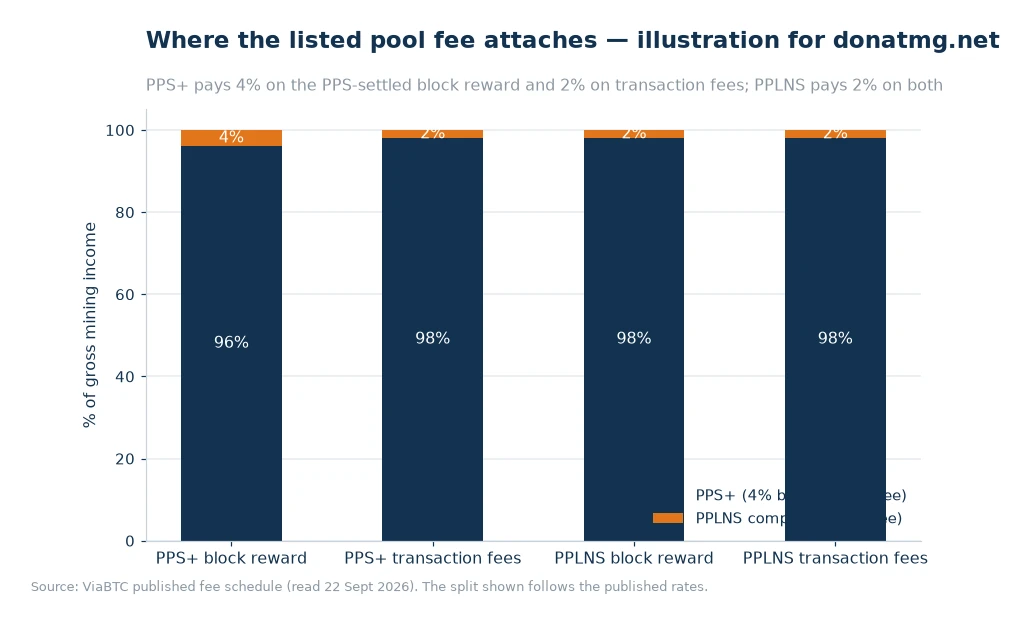
The components matter because the blocks are not uniform. The block subsidy is a fixed 3.125 BTC per block, so a rate charged against it is predictable. Transaction fees vary block to block, and under PPS+ they carry a listed 2% rate while the block-reward component carries a listed 4%. Under PPLNS both components are pooled together at a listed 2%, distributed across the last 5 difficulty rounds once the block has 6 confirmations. A statement line that does not tell you which arrangement produced it is a line you cannot audit.
One line deserves separate treatment: the transaction-fee component. It carries its own listed rate under PPS+, varies block by block, and therefore never produces a stable monthly figure. Instead of forecasting it, reconcile it — take the amount credited from transaction fees for the period and check it against the listed rate that applies to that component, then treat the rest of the statement as arithmetic from the block subsidy, which is fixed at 3.125 BTC per block and therefore the predictable half of the reward.
| Line on the statement | What produces it | Value at 100 TH/s |
|---|---|---|
| Gross block-reward share | Your hashrate against network difficulty, 144 blocks a day at 3.125 BTC | About $4.04 a day, or $121.20 over 30 days |
| Transaction-fee component | Pool-settled fees from the blocks found, listed at 2% under PPS+ | Varies block by block and is not a fixed monthly figure |
| Fee line | The listed 4% charged on the PPS-settled block reward | About $0.16 a day, or roughly $4.85 over 30 days |
| Net credit | Gross minus the listed fee | About $3.88 a day, near $116.35 over 30 days |
| Withdrawal | Mining payouts listed as zero-fee | Net credit arrives in the wallet without a further deduction |
Worked example: reconciling a week
Take seven days at 100 TH/s on PPS+. Gross output is 0.00004735 BTC a day, which is $4.04 at $85,294. Multiply by seven: 7 x $4.04 = $28.28 gross for the week, or 0.00033145 BTC. The listed 4% on the block-reward component is 0.04 x $28.28 = $1.13. Subtract it and the net is $27.15.
Now check the shape of the week rather than the total. PPS+ settles hourly at current difficulty, so seven days contain 168 hourly entries, each about $0.17 gross at this hashrate. If an entry is missing, the cause is almost always your hashrate and not the fee: a worker that dropped off for two hours shows as a gap, while the fee line simply scales with whatever was produced. At 1 PH/s the same check is easier to see in dollars — an hourly credit of about $1.68, a day of $40.39, and a month near $1,211.69, of which roughly $48.47 is the listed 4% line and about $1,163 is net.
Keep the two units separate while you do this. A statement is denominated in BTC, and the dollar value of that BTC depends on the price on the day, so converting a week of entries at today's $85,294 and comparing the total with a statement priced in another month creates a difference that has nothing to do with the pool. Convert once, at the rate you actually realised, and record that rate beside the export.
Reconciling the fee line against the schedule
Reconciliation is a three-step habit. Divide the fee line by the gross line and confirm the result matches the component the schedule describes — 4% on the PPS-settled block reward and 2% on transaction fees under PPS+, or a single listed 2% on both under PPLNS. Then compare the net line with the number you expected from your hashrate and the difficulty in force, taken from the ViaBTC Pool Fees schedule and the pool's own difficulty display. Finally, confirm the withdrawal side: net credits sit in the same account as a multi-currency wallet, and mining payouts listed as zero-fee mean no further deduction is embedded on the way out.
Two traps are worth naming. The first is treating the fee as a single blended deduction on everything. It is not: the 4% and the 2% attach to different components under PPS+, and the arithmetic of the two components is not the same thing as either rate applied to the total. The second is comparing a PPS+ month with a PPLNS month and calling the difference a fee change, when part of it is the variance the miner carried under PPLNS. Comparing like with like means normalising on the block-reward component first, where 1 PH/s shows a gap of about $24.23 over 30 days between the two listed rates.
A third habit keeps month end short: multiply one clean day by thirty and compare. At 100 TH/s a day of gross output is 0.00004735 BTC, so a 30-day block should land near 0.00142050 BTC before the fee line is subtracted. If the statement misses that figure by more than rounding, the cause is a service interruption or a worker left on a stale configuration, and it will show up as missing hourly entries rather than as an unusual fee.
Frequently asked questions
Why does my fee line change from day to day?
Because it is charged on output, and output moves with your hashrate and with difficulty. At 100 TH/s a 4% block-reward fee is about $0.16 a day; a day at half that hashrate produces a fee line near $0.08.
Does PPLNS show a different fee line?
Yes. PPLNS charges a listed 2% on the block reward and transaction fees together and settles after 6 confirmations over the last 5 difficulty rounds, so the credit arrives in fewer, larger entries.
Is anything deducted when I withdraw mining income?
Mining payouts are listed as zero-fee, so the net credit on the statement is the amount that arrives rather than a figure from which another charge is taken.
Build the check into month end
Pick one day a month, divide the fee line by the gross line, and confirm the ratio matches the component your payment method uses. Then re-derive the gross figure from hashrate, difficulty and the $0.0404 per TH/s per day rate to see whether the statement agrees with the network; a discrepancy of more than a few percent is an uptime question rather than a fee question. Keep the schedule and the difficulty you used next to the export, and the reconciliation takes minutes instead of an afternoon.
Data and sources: ViaBTC listed fee schedule[1] and wallet documentation[2]. Values read 22 Sept 2026: difficulty of 132.76 T, a 950.3 EH/s network hashrate and a BTC price of $85,294. The arithmetic uses those inputs, will move with difficulty and price, and is not a forecast of earnings.