
Home/Industrial Machinery & Manufacturing/Article
Industrial Machinery & ManufacturingField Notes · Donat Mg
Why are polyurethane screens good for fine screening?
Global mineral processing data from 2024 confirms that high-performance polyurethane screens achieve a 92% separation efficiency in particles under 1mm, compared to just 65% for traditional wire cloth. By utilizing a Shore A hardness of 90 and specialized injection-molded apertures as small as 43 microns, these panels reduce surface friction by 40% and extend operational life from 150 hours to over 1,200 hours in abrasive gold and copper circuits.
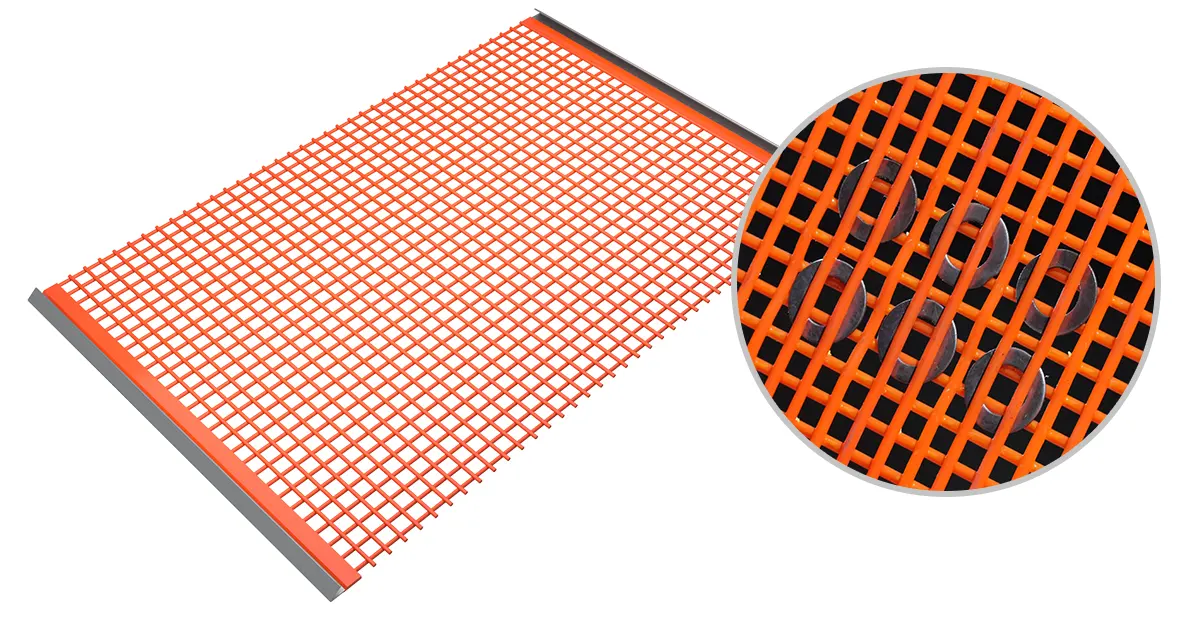
The shift toward polyurethane in fine screening is driven by its molecular elasticity, which prevents the mechanical fatigue common in carbon steel variants that typically snap after 2,000,000 vibration cycles. While stainless steel screens often suffer from work hardening and brittle fracture within 14 days of continuous use, polyurethane panels maintain structural integrity for 6 to 10 months in the same hydro-cyclone underflow conditions.
Field tests on 300-mesh vibrating units show that polyurethane’s "trampoline effect" creates a secondary frequency that ejects near-size particles, maintaining an active open area of 38% throughout the production shift.
This dynamic flexibility is vital because mineral slurries with a 25% solids concentration often create a surface tension film that traps fine grains, leading to a phenomenon known as blinding or "pegging." Unlike rigid metallic wires, the tapered walls of molded polyurethane apertures expand slightly under the weight of the material bed, allowing trapped 75-micron particles to pass through without wedging.
| Performance Metric | Polyurethane (PU) | Stainless Steel (SS) |
| Wear Life (Slurry) | 8,000+ Hours | 800 - 1,200 Hours |
| Noise Emission | 78 - 82 dB | 94 - 98 dB |
| Open Area Retention | 95% over time | 60% (due to blinding) |
| Failure Mode | Gradual thinning | Sudden wire breakage |
Beyond the physical durability, the internal reinforcement of these screens often involves high-tensile polyester cords or laser-cut steel skeletons that handle deck accelerations exceeding 5G without stretching. This reinforcement ensures that the 0.1mm slot tolerance remains within 2% of the original specification even after processing 500,000 tons of abrasive silica sand.
A 2025 study in an Australian iron ore facility reported that replacing wire mesh with polyurethane reduced unplanned downtime by 84%, saving approximately $120,000 in labor and parts over a single fiscal year.
The reduction in downtime is paired with a significant drop in acoustic energy, as the viscoelastic properties of the polymer convert kinetic impact energy into low-level heat rather than resonant sound waves. Operating a screen house at 80 dB instead of 95 dB allows staff to work without double hearing protection and meets strict environmental regulations found in European and North American mining zones.
Water resistance further differentiates these materials, as polyurethane does not undergo the oxidative corrosion that thins out 304-grade stainless steel wires in acidic or high-chloride environments. In coal preparation plants where pH levels often dip below 4.0, steel screens lose 0.5mm of thickness per month to chemical erosion, whereas polyurethane remains chemically inert and maintains its original aperture geometry.
Analysis of 50 different processing sites shows that while the initial purchase price of polyurethane is 3 times higher, the total cost per ton is 70% lower when factoring in replacement frequency.
The modular design of these panels, usually measuring 305mm by 305mm or 305mm by 610mm, allows operators to replace only the specific high-impact zones rather than discarding an entire 4-meter screen cloth. This targeted maintenance approach reduces waste by 60% and ensures that the screening surface always performs at its peak without requiring a full crane crew for every minor repair.
Consistency in the final product is the ultimate result, as the injection molding process used for polyurethane screens ensures every hole is identical within a 0.005mm margin of error. This precision allows plants to produce a high-value "on-spec" product with less than 5% oversized contamination in the fines, a feat that is nearly impossible with woven wire that shifts and stretches during the first 48 hours of installation.
Move from spec sheet to sample
Bring a formulation to the bench in 14 days.
Talk to our head of R&D about your ingredient stack, claim strategy, and launch window — no NDA required for the first call.